
The British Raj
[The Ink Never Fades]

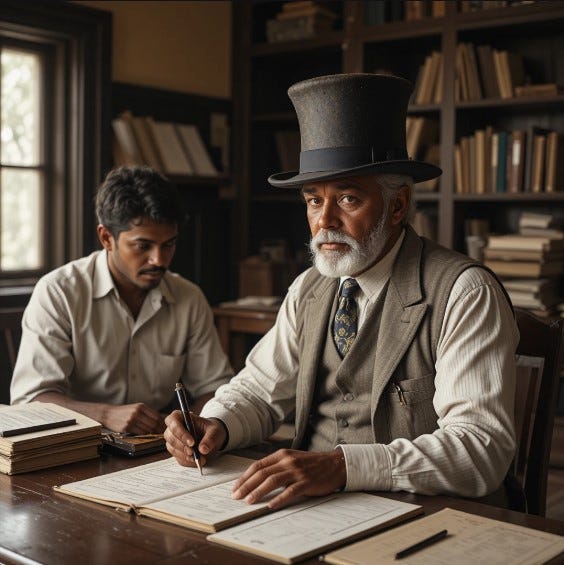
In the bustling port city of Trincomalee, in old Ceylon, the air was a thick soup of sea salt, jasmine, and the acrid smoke of the newly established steam-mills. Jayantha, a young clerk in the district’s administrative office, spent his days translating traditional land deeds into the rigid, ink-heavy ledgers of the colonial Authority.
“The ink is different this year, Jayantha,” his grandfather, Silva, said one evening as they sat in the courtyard of their ancestral home. Silva had once been a master weaver, but the local market was now flooded with cheap, machine-made textiles from the factories of the fatherland.
“It’s imported, Grandfather,” Jayantha replied, his fingers stained a permanent charcoal hue. “It’s designed not to fade for a hundred years. The Authority says permanence is the foundation of a modern civilization.”
Silva looked at the sprawling hills beyond the city, where the ancient communal forests were being partitioned into plantations. “They trade our cycles of growth and decay for a permanence that feels like a tomb.”
The conversation shifted when a neighbor, Malik, joined them. Malik had recently lost his small farm because he could not produce a ‘modern’ title deed recognized by Jayantha’s office.
“They told me the land no longer belongs to my family because our name wasn’t in the Great Ledger,” Malik spat, his voice trembling. “My father’s father was buried under that kottang tree. Is that not a title deed?”
Jayantha looked down at his hands. “The law says that land not being ‘productively utilized’ according to the industrial standard is considered ‘vacant’. I only record what the system dictates, Malik.”
“You record our disappearance,” Silva whispered.
The impact of this new order was visible everywhere. The colonial administration had built a magnificent railway, but its tracks only ran from the mines to the docks, bypassing the villages that needed transport for their crops. The “development” was a hollow straw, designed to suck the marrow from the land and ship it across the ocean.
A week later, Jayantha sat across from his supervisor, Mr Thorne, an administrative official of the British Raj, who viewed the colony as a vast, unfinished puzzle.
“You see, Jayantha,” Thorne said, gesturing to a map of Trincomalee. “We are bringing order to the chaos. Look at these straight lines. Efficiency is the greatest gift we can give to the developing world.”
“But the lines cut through the irrigation canals our ancestors built, Mr Thorne,” Jayantha ventured. “The water doesn’t flow to the lower fields anymore. The people are hungry.”
Thorne sighed with the practiced patience of a man who believed he was burdened by a civilizing mission. “Progress has a price. They must learn to adapt to the global market. If they cannot grow grain, they must work the rubber lines. That is the nature of the modern economy.”
Jayantha returned home that night to find Silva staring at a single piece of cloth he had woven by hand.
“They offered to buy the house, Jayantha,” Silva said. “The Authority wants to widen the road for the timber trucks.”
“We have no choice,” Jayantha said, the words tasting like ash. “The compensation they offer is based on the ‘market value,’ which they control.”
“It isn’t just the house,” Silva replied. “It’s the memory of what we were before we became ‘developing.’ When did we become poor, Jayantha? We had everything we needed until they told us our things had no value in their ledgers.”
As the years passed, Trincomalee grew taller and grimmer. The forests vanished, replaced by a grid of plantations that served a distant stock exchange. The young men left their families to work in the mills, trading their independence for a weekly wage that barely covered the cost of imported food.
One evening, Jayantha sat in his office, now a senior clerk. A young man, not unlike his younger self, brought him a stack of ledgers.
“Sir, the villagers in the north are protesting,” the young clerk said. “They say the new mining project has poisoned their wells.”
Jayantha looked at the map on his wall, the same one Thorne had used decades ago. The straight lines were now deep scars.
“Draft a response,” Jayantha said, his voice cold and precise. “Tell them the project is vital for the nation’s GDP. Tell them that development requires sacrifice.”
He looked at his stained fingers. The ink had finally done its work. It had rewritten the world until the people living in it could no longer recognize their own history. The colony had been ‘developed,’ but the people had been left behind in a landscape of straight lines and empty wells.
“Grandfather was right,” Jayantha whispered to the empty room. “The ink never fades. It just hides the blood underneath.”
“The ink never fades. It just hides the blood underneath.” is a devastating closing line.
What stayed with me throughout the piece is how colonization is shown not only through violence, but through ledgers, maps, efficiency, classifications, and the quiet rewriting of value itself. The tragedy becomes deeper because people slowly begin speaking the language that erased them.
“You record our disappearance” carried enormous weight too.
The story feels less like historical fiction and more like a meditation on how systems reshape memory until entire generations can no longer recognize what was taken from them.
The Western empire convinces us that "civilized" means becoming like them, while all along they are the uncivilized barbarians.
This was beautiful and heartfelt, especially as we continue watching colonization happen on the screens of our phones.