
Timur
[An Empire To Be Remembered]

History:
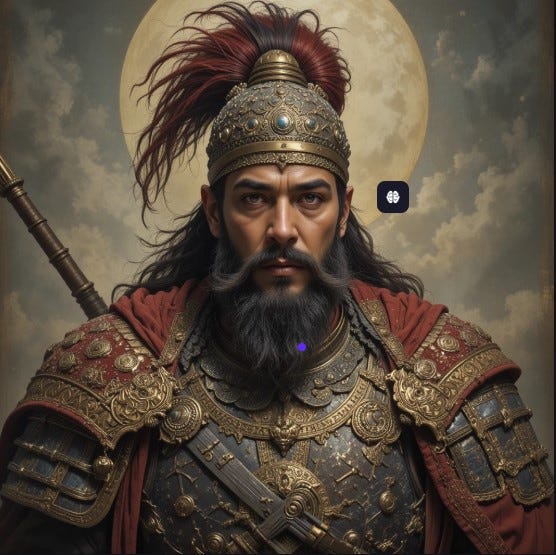
Timur, widely known as Tamerlane (a corruption of Timur-i-Lang or “Timur the Lame”), was one of history’s most formidable and polarizing conquerors. Born in the 1330s near Samarkand, he founded the Timurid Empire, which at its height spanned from modern-day Turkey and Egypt to the borders of India and Russia.
He remains a central figure in world history:
1. The “Sword of Islam” and the “Lame” Conqueror
· The Name: He gained the nickname “the Lame” due to injuries sustained to his right hand and leg during a skirmish in his youth (likely while stealing sheep or in early tribal warfare).
· Religion: Unlike the earlier pagan Mongol conquerors, Timur was a devout Sunni Muslim. He often styled himself as a Ghazi (a holy warrior) to justify his conquests, though he frequently attacked fellow Muslim states.
2. A Military Genius with a Brutal Reputation
Timur was never defeated in a major battle. However, his military brilliance was often overshadowed by his extreme cruelty:
· The “Tower of Skulls”: He was infamous for massacring entire city populations that resisted him. In places like Isfahan and Baghdad, he reportedly ordered his soldiers to build pyramids or towers made from the severed heads of the inhabitants.
· The Defeat of the Ottomans: In 1402, he crushed the rising Ottoman Empire at the Battle of Ankara, capturing Sultan Bayezid I and delaying the Ottoman expansion into Europe for decades.
· The Sack of Delhi: In 1398, he invaded India, leaving Delhi so devastated that it reportedly took the city over a century to recover.
3. The Quest for Legitimacy
Timur faced a unique political problem: he was not a direct descendant of Genghis Khan. According to the laws of the Steppe, only a “Chinggisid” (blood descendant of Genghis) could claim the title of Khan.
· The Solution: Timur ruled through “puppet” Khans who were descendants of Genghis. He took the title of Amir (commander) and married a princess from Genghis Khan’s lineage, earning him the title Gurkani (”Son-in-law”).
· The Legacy: This obsession with legitimacy passed down to his descendants, the Mughals, who took great pride in their “Gurkani” status.
4. Cultural Patronage: The Timurid Renaissance
Despite the carnage he caused abroad, Timur turned his capital, Samarkand (in modern Uzbekistan), into one of the most beautiful cities in the world.
· He forcibly relocated the finest architects, poets, and scholars from his conquered lands to Samarkand.
· This led to a “Timurid Renaissance,” marked by breathtaking blue-domed mosques (like the Bibi-Khanym Mosque) and advancements in astronomy and mathematics.
5. Why he matters today
· Founder of a Dynasty: He was the direct ancestor of Babur, who founded the Mughal Empire in India. The Mughals considered themselves “Timurids” first and “Mughals” second.
· National Hero: In modern Uzbekistan, Timur is celebrated as a national hero and a symbol of statehood, with massive statues replacing former Soviet monuments in cities like Tashkent.
Timur died in 1405 while on his way to invade Ming China. His tomb, the Gur-e-Amir in Samarkand, remains one of the greatest masterpieces of Islamic architecture
Ancestry:
To understand Timur’s ancestry, one must look at the Barlas tribe, a Turco-Mongol confederation that inhabited the Transoxiana region (modern-day Uzbekistan). While Timur was not a direct blood descendant of Genghis Khan, his ancestors were deeply intertwined with the Mongol Empire’s elite.
Breakdown of his lineage:
1. The Paternal Line: The Barlas Clan
The Barlas Clan (The Real Lineage)
Tamerlane belonged to the Barlas tribe, a group of nomadic pastoralists in Central Asia. His lineage on his father’s side goes back several generations through prominent tribal military leaders:
Taraghay Noyan (Father): A minor noble and chief of the Barlas clan.
Burgul Noyan (Grandfather) and Aylangir (Great-Grandfather): Both were military commanders within the Chagatai Khanate (the Central Asian successor state of the Mongol Empire).
Qarachar Noyan (Distant Ancestor): A highly influential military commander who served under Chagatai Khan (Genghis Khan’s son) in the early 1200s. Qarachar was the ancestral patriarch who originally settled the Barlas clan in the Transoxiana region.
The Connection to Genghis Khan: Fact vs. Fiction
To rule with absolute authority, Tamerlane needed a connection to Genghis Khan. His court genealogists traced both Tamerlane’s line and Genghis Khan’s line back to a shared, semi-mythical Mongol ancestor: Tumanay Khan (also known as Tomana Khan).
According to official Timurid history:
1 Tumanay Khan had twin sons: Qachuli and Khabul.
2 Khabul Khan became the ancestor of the royal line that produced Genghis Khan.
3 Qachuli became the ancestor of the Barlas clan that produced Tamerlane.
While modern historians view this exact “twin pact” story as political propaganda invented to justify his rule, it is true that the Barlas clan was ethnically Mongol in origin before becoming thoroughly “Turkified” over the generations.
1. How He Bypassed the “Genghis Barrier”
Because this distant cousin connection wasn’t enough to legally make him a Khan, Tamerlane used a loophole: marriage.
He married Saray Mulk Khanum, a direct princess of the Genghisid line. By doing this, Tamerlane took the official title of Guregen (meaning “Son-in-Law” of the Great Khan). He never called himself Khan, ruling instead through puppet Genghisid khans while holding the real power under the title of Amir (commander).
Timur’s father was Taraghay, a minor noble and the chief of the Barlas tribe. Taraghay was a pious man who retreated from the chaos of tribal politics toward a life of religious study, but he belonged to a long line of warriors.
· Tumanay Khan: A legendary great-grandfather of Timur. According to Timurid tradition, Tumanay Khan had twin sons: Qabul and Qachuli.
o Qabul Khan was the ancestor of Genghis Khan.
o Qachuli Bahadur was the ancestor of Timur.
This “twin” legend was used by Timurid historians to argue that the two families had a divinely ordained pact: Genghis’s line would provide the Khans (political rulers), and Timur’s line would provide the Amirs (military commanders).
2. The Mongol Connection: Qarachar Barlas
The most historically significant ancestor of Timur was Qarachar Barlas.
· He was a high-ranking military commander under Chagatai Khan (the second son of Genghis Khan).
· Qarachar served as a “vizier” or advisor and was granted lands in the Kashka-Darya valley (near the city of Kesh, where Timur was born).
· Through Qarachar, Timur claimed the hereditary right to serve as the “protector” of the Chagatai Mongol line.
3. The Quest for Legitimacy
Because Timur lacked the “Golden Kin” bloodline (direct descent from Genghis Khan), he could never legally call himself “Khan.” To fix this, his “ancestral” claims were bolstered by two specific strategies:
· The Gurkani Title: He married Sarai Mulk Khanum, a direct descendant of Genghis Khan. This allowed him to call himself Gurkan (Son-in-law of the Khan), effectively “joining” the family he wasn’t born into.
· The Spiritual Lineage: Timur claimed a spiritual ancestry through his mentor, the Sufi saint Sayyid Baraka, claiming his authority came from a divine source as much as a genealogical one.
The religious identity of Timur’s lineage is a fascinating blend of shifting loyalties, transitioning from the ancient shamanism of the steppes to a sophisticated, Persian-influenced Islamic culture.
To understand what they followed, we have to look at the three distinct phases of his ancestry and his own life.
1. The Early Ancestors: Shamanism and Tengrism
Timur’s distant Mongol and Barlas ancestors (pre-1300s) followed Tengrism.
· The Belief: This was the traditional Central Asian belief system centered on Tengri, the “Eternal Blue Sky.”
· Practices: It involved shamanism, ancestor worship, and a deep spiritual connection to nature. Even after the Mongol Empire began to fracture, many of the nomadic elite clung to these traditions, believing the Sky gave the Khans the divine right to rule.
2. The Great Transition: The 13th and 14th Centuries
As the Barlas tribe settled in Transoxiana (modern-day Uzbekistan), they became “Persianized.” This region was a major hub of Islamic learning (home to cities like Bukhara and Samarkand).
· Conversion: By the time of Timur’s father, Taraghay, the Barlas tribe had almost entirely converted to Sunni Islam.
· The Influence of Sufism: The Islam practiced by Timur’s family was heavily influenced by Sufism (Islamic mysticism). His father was known to be a very pious man who spent his final years in the company of Sufi dervishes and scholars.
3. Timur’s Personal Faith: A Political Tool
Timur himself was a Sunni Muslim, but his personal “religion” was often a mix of deep personal piety and cold, hard political strategy.
· Sufi Mentors: Timur had a profound respect for Sufi saints. His most famous spiritual advisor was Sayyid Baraka, a descendant of the Prophet Muhammad. Timur was buried at the feet of Baraka in the Gur-e-Amir mausoleum.
· The “Sword of Islam”: He used religion to justify his brutal conquests. When he attacked the Christian Knights of Rhodes or the Hindu kings of India, he claimed to be a Ghazi (a warrior for the faith).
· Contradictions: Despite his Sunni identity, he held a deep, almost cult-like reverence for Ali ibn Abi Talib (the central figure of Shia Islam). He used this to justify attacking the Sunni Ottoman Sultans and the Mamluks, claiming they weren’t “proper” Muslims.
· The Yassa vs. Sharia: Timur famously balanced two legal codes: the Sharia (Islamic law) and the Yassa (the Mongol code of Genghis Khan). If the two clashed, Timur usually chose whichever one gave him more power in the moment.
4. The Descendants (The Mughals)
By the time the lineage reached Babur (the founder of the Mughal Empire in India), the religion was firmly Sunni Islam, but it was an incredibly cosmopolitan and intellectual version of it.
· They were patrons of Persian literature, art, and philosophy.
· This lineage eventually produced Akbar the Great, who was famous for his religious tolerance and his attempt to create a syncretic faith called Din-i-Ilahi.